
Why bearing steel wire is a system decision, not a line item
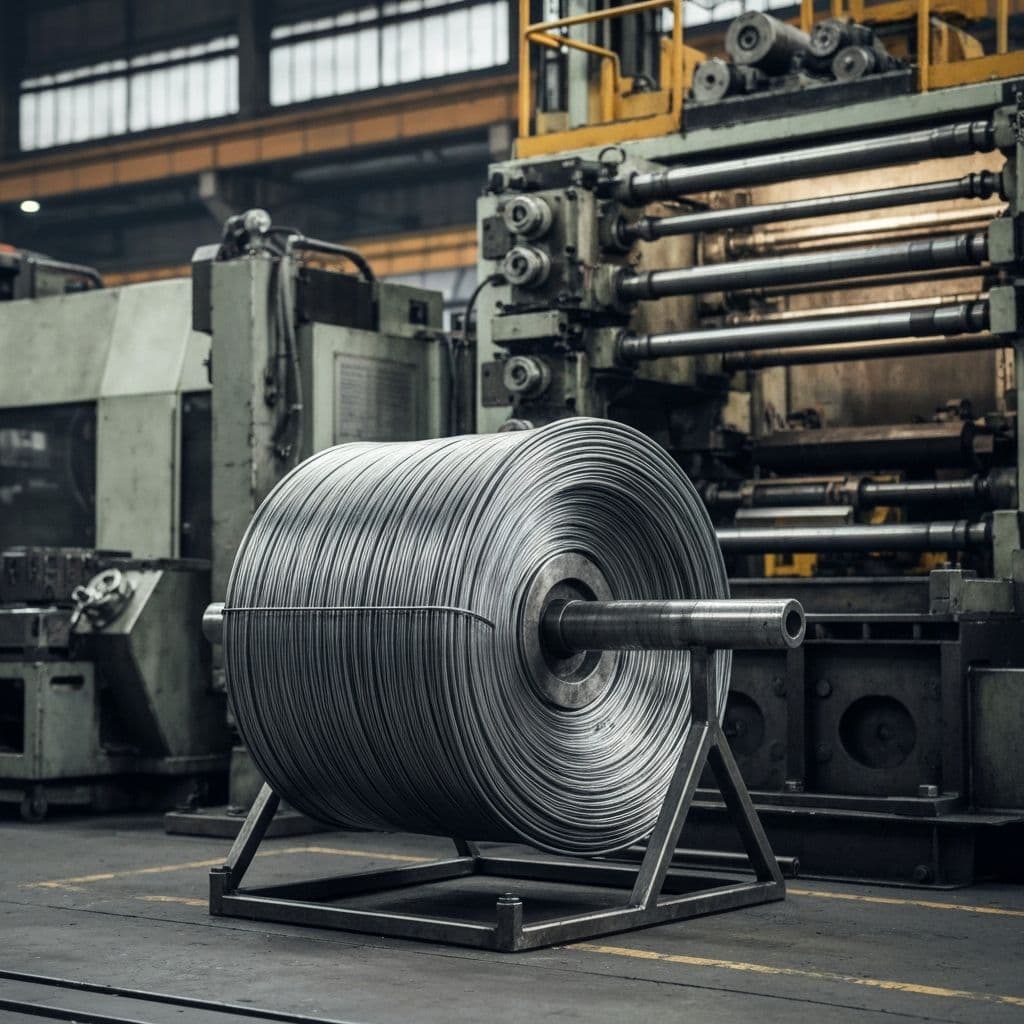
Bearing steel wire is the input stock from which small bearing components — most relevantly here, needle rollers — are cut, formed, heat treated, ground, and finished. For a procurement engineer, the wire purchase is effectively a purchase of downstream process yield. Two lots that meet the same chemistry specification can behave differently in heading, annealing, hardening, and grinding if cleanliness, carbide structure, or diameter consistency differ.
The reference product here is GCr15 high-carbon chromium bearing steel wire, supplied for needle roller, ball, and precision bearing component production. GCr15 is the Chinese designation for a through-hardening bearing steel broadly comparable in role to 100Cr6 / SUJ2; the existing material-selection article on this site covers grade matching across environments, so this guide stays on wire-form evaluation: what the wire condition does to your process, and how to verify it before release to production.
What the wire specification should control
A wire certificate that lists only chemistry is not enough for needle roller production. The purchasing specification should tie each requirement to a downstream effect, so that a nonconformance can be argued in process terms rather than as a paperwork dispute.
| Wire characteristic | Why it matters downstream | What to ask the supplier to state |
|---|---|---|
| Chemical composition (GCr15 range) | Sets hardenability and the achievable hardness after austenitizing and tempering; deviations shift dimensional response during heat treatment | Cast/ladle analysis per heat number, with the grade standard referenced |
| Non-metallic inclusion content | Inclusions act as stress raisers and are a recognized fatigue initiation site in rolling contact; cleanliness is therefore a fatigue-life variable, not a cosmetic one | Inclusion rating method and rating limits, with the test standard named |
| Carbide distribution and banding | Uniform carbide distribution supports consistent response to spheroidize annealing and hardening; severe banding can produce hardness and microstructure variation along the part | Microstructure acceptance description and the sampling location |
| Diameter and ovality tolerance | Affects cut length consistency, heading/forming fill, and the stock allowance left for grinding | Tolerance band, measurement method, and whether it applies to the coil or the straightened cut length |
| Surface condition and decarburization | Surface defects and decarburized layers can survive into the finished roller if grinding allowance is insufficient | Decarburization depth limit and surface-defect acceptance criteria |
| Delivery condition (annealed / spheroidize annealed / cold drawn) | Determines formability before hardening and the amount of in-house annealing required | Condition stated explicitly, with hardness or tensile range for that condition |
Each row above should appear in your purchase order or technical agreement, not only in a datasheet. The supplier's general description — high purity, uniform microstructure, excellent hardenability, superior fatigue resistance, consistent wire diameter — describes intent; the specification converts intent into an accept/reject rule.
Wire condition and the needle roller process chain
Needle rollers are cylindrical rolling elements used in needle roller bearings, where a small radial envelope must carry high load. The manufacturing route typically runs: wire → cut to length → forming or heading of ends where required → spheroidize anneal (if not supplied annealed) → hardening and tempering → grinding and superfinishing → inspection and sorting. Wire condition interacts with each step.
Before hardening: formability and annealing response
If you buy cold-drawn wire in a hard condition, you own the spheroidize annealing step and its variability. If you buy spheroidize-annealed wire, you are buying a softer, more formable structure and a more predictable response to your own austenitizing cycle — but you are also relying on the supplier's annealing control. The trade-off is capability versus control: in-house annealing gives you the ability to tune the cycle to your furnace and part size, at the cost of another process to validate and monitor.
During hardening: dimensional and hardness response
Through-hardening steels respond to austenitizing temperature, quench, and tempering. Chemistry within the grade band, prior microstructure, and decarburization all influence the result. A wire lot with heavy surface decarburization can produce soft spots after hardening that only appear at final hardness inspection — by which point the cost of the lot has multiplied through every preceding operation. This is the practical argument for incoming verification of surface condition rather than relying on the mill certificate alone.
After hardening: what the wire can no longer fix
Grinding removes stock to reach final diameter, roundness, and surface finish. If the incoming wire diameter runs at the low end of tolerance while your process assumes nominal, you may have insufficient allowance to grind out decarburization or distortion. Diameter tolerance and decarburization depth therefore need to be specified together, not independently.
Incoming verification: a practical inspection sequence
The following sequence is a starting framework for a receiving inspection plan. The specific tests, sample sizes, and acceptance limits must be agreed with your customer's drawing requirements and your own quality system; the point here is the order of checks, from cheapest and fastest to most involved.
- Documentation check. Confirm heat number traceability, grade designation, delivery condition, and that the certificate reports the characteristics named in your specification — not a generic template.
- Dimensional check. Measure diameter and ovality at multiple points along the coil or cut length, using a method agreed in the specification. Record the measurement method; results are not comparable across different gauges.
- Surface inspection. Look for seams, cracks, scale, and handling damage. Where the specification sets a decarburization limit, verify it metallographically on a cross-section rather than by visual inspection alone.
- Microstructure check. Assess carbide distribution and, for annealed wire, the spheroidization condition against the agreed acceptance description. This is the check most often skipped and most often responsible for surprises at hardening.
- Hardness or tensile check in the delivery condition. Confirms the wire is in the condition you ordered and gives a baseline for later comparison.
- First-article process trial. Run a small batch through your actual forming and heat treatment route and measure hardness, case depth (where relevant), distortion, and grindability. This is the only check that validates the wire against your process rather than against a generic standard.
For repeat orders, the first-article trial can be reduced to periodic revalidation, but the documentation and dimensional checks should remain on every lot.
Common failure modes and where they originate
Most needle roller quality escapes trace back to a small set of wire-related causes. Knowing them helps you write acceptance criteria that catch the problem at goods-in rather than at final inspection.
- Fatigue spalling at the roller surface. Often associated with inclusion content or surface defects that act as initiation sites. The purchasing lever is a specified inclusion rating with a stated test method, plus surface-defect acceptance criteria.
- Hardness scatter after heat treatment. Can follow from carbide banding, decarburization, or inconsistent prior microstructure. The purchasing lever is a microstructure acceptance description and a decarburization limit, verified on cross-sections.
- Dimensional nonconformance after grinding. Frequently a stock-allowance problem: wire at the low end of diameter tolerance combined with distortion leaves too little material to grind. The purchasing lever is a tolerance band agreed against your actual allowance calculation, not a catalogue default.
- Forming cracks or excessive die wear. In cold forming of roller ends, surface condition and the wire's delivery hardness dominate. The purchasing lever is an explicit delivery condition with a hardness range, and a surface-quality criterion.
- Lot-to-lot process drift. Even within specification, a change of heat or supplier can shift your process window. The purchasing lever is change notification: require the supplier to inform you before changing steel source, annealing route, or drawing process for an approved part.
Supplier qualification questions that reveal real capability
Supplier questionnaires tend to produce similar answers. The questions below are harder to answer generically, and the quality of the response tells you more than a certificate package.
- Which standard and grade designation do you certify against for GCr15 wire, and can you show a certificate for a recent heat with the inclusion rating method named?
- What is your stated decarburization limit, and at what sampling location is it measured?
- For annealed wire, how do you describe and verify spheroidization? What does a rejected microstructure look like in your acceptance procedure?
- How do you control diameter along the coil, and what is the measurement method and frequency?
- What is your change-notification process for steel source, heat treatment subcontractor, or drawing route?
- Can you supply a small trial quantity against a written specification before we commit to production volumes?
The last question matters most. A trial quantity against a written specification, run through your own process, converts a supplier's claims into evidence you can act on. Treat the trial result as the basis for the production agreement, and record the agreed specification revision so that later lots are judged against the same document.
How this fits with precision needle rollers and other wire products
If you buy finished precision needle rollers rather than wire, the same characteristics appear as incoming inspection criteria on the roller: dimensional accuracy, surface finish, hardness consistency, and freedom from surface defects. The difference is where the risk sits. Buying wire moves material and heat-treatment risk into your plant; buying finished rollers moves it to the supplier, but makes your verification dependent on their inspection and on the specification you agreed with them. Neither route removes the need for a written, characteristic-level specification.
Bearing steel wire is one of several wire forms in this product family; spring steel wire and cold-heading screw wire are specified against different properties and are covered in separate guides. For needle roller production specifically, the evaluation sequence in this article — specification by downstream effect, incoming verification in cost order, and a process trial before volume commitment — is the part that transfers regardless of which supplier you ultimately qualify.